| [ Home ] | [ Photo Diary ] | [ Image Gallery ] | [ Contact Me ] |
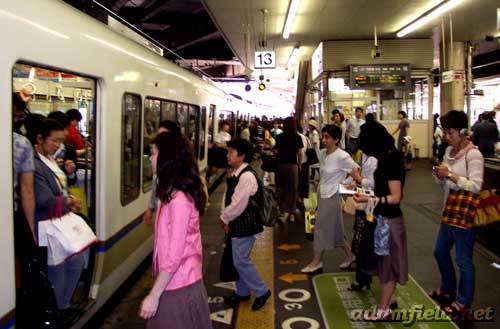
Following my meal of Okonomi Yaki, I said farewell to Mako and made my way to Kyoto where I had a reservation at the Tour Club hostel. I made my way, of course, by train. Trains play a big part in Japanese life, and there are few places on the archipelago that you can't reach by rail. I took a handful of train rides, and it was rare that I didn't see three or four people sleeping in their seats.
|
| A line of female travelers embark from Namba station, walking over a green sign painted on the platform declaring 'Boarding Point for Women Only'. |
The sun was setting as I arrived, so I quickly made my way to the hostel, dropped off my bags, hired a bicycle, and headed off to explore. The main high-street in Kyoto was ablaze with neon, and buzzing with people. Shops, restaurants and pachinko parlours lined the street, which was lit with Japanese lanterns. I had a relaxing evening exploring with my camera.
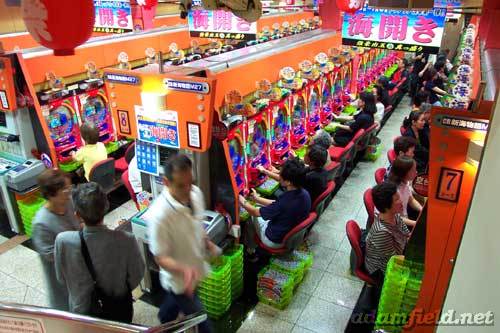 |
| Pachinko, a gambling game which sits somewhere between pinball and fruit machines, provides noisy entertainment to the Japanese public. |
After a pleasant sleep in the girls' dorm room of the hostel I headed out with a tour of five sites in mind. The rain was coming down, and didn't let up all day, but I didn't let that put me off. Joining the throngs of Kyoto cyclists with one hand on the handlebars and one hand holding a cheap plastic umbrella I headed to Sanjo-Sangen temple. The attraction of this temple is the 1000 statues in the main hall. Seven to eight hundred years old, these statues represent the god Juichimen-senju-senge Kanzeon, or Kannon for short. The statues are made of wood, and covered with gold leaf. They have 42 arms each, symbolic of 1000 arms that Kannon has to comfort and protect the people. The sheer scale of 1000 1.5 meter high statues, and one 3 meter statue took my breath away. In front of the statues were 28 guardian statues, graphic representations of deities who protect Kannon and the monks who serve him. Each statue has a different face, and worshippers leave offerings to the statue they feel looks like them or one of their relatives.
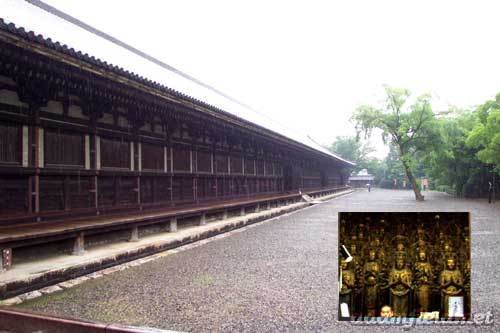 |
| The 120 meter long hall of Sanjo-Sangen temple holds 1001 statues of Kannon (inset), a god with 1000 arms with which to help and comfort mankind. Every January since 1606, an archery tournament is held along its length. |
My wet route to the next site coincided with lunch time, so I stopped at a snack bar and bought a delicious lunch for 500yen (about 2.50gbp) which consisted of pork, chicken, beef, noodles, rice and a small side of salad and mashed potato. These meals were a staple for me in Japan as they were cheap, healthy and readily available. I consider eating healthily while traveling to be more important than good sleep. I found an empty covered car park, out of the rain, and shared my lunch with the pigeons.
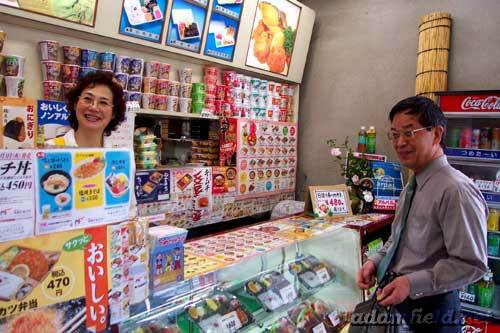 |
| A salaryman grabs a lunch tray at a snack bar in Kyoto. Plastic trays like these are a widely available quick meal, usually bought cold in a supermarket or convenience store. |
 |
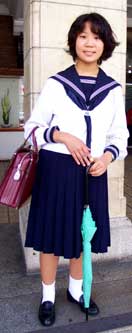
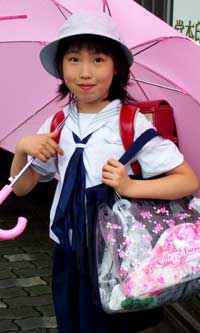
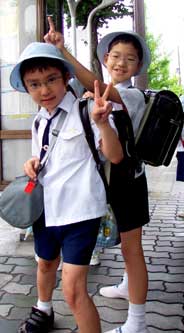
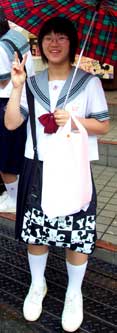
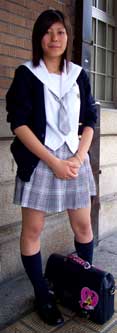
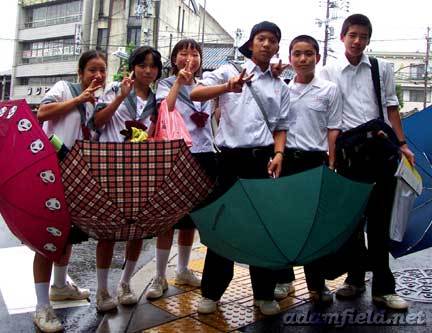
My next stop was Kiyomizu-Dera, a temple complex overlooking the city. This entailed pushing my bike up some very steep, very narrow, very crowded streets. I'm not certain, not having spent enough time in Japan, but I think the whole hill was a tourist trap. There were shops everywhere selling fans, statues, kimonos and anything else remotely Japanese. Young people in school uniforms were everywhere. The Japanese school uniforms are an interesting cultural part of Japan. I was informed that many school operate strict codes where both the boys and the girls must have their hair cut above their collars. Schools are much larger, with class sizes of fifty students the norm. Some students have a pretty long commute to school. However, like the Koreans, they don't finish studying when school ends. As well as homework, they also attend small private schools in the evening to study.
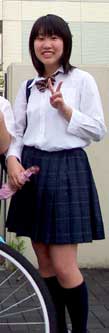 |
| Students of various ages pose in their school uniforms, including 'sailor girl' costumes. These uniforms can be seen all hours of the day, as Japanese students are kept so busy that they don't want to waste time going home to change. |
Kiyomizu temple had a steady stream of people walking through it, despite the weather. It was hard to gauge how many were worshippers and how many were tourists. Spectacularly situated on the side of a hill, the main building was supported by a framework of wooden pilings. A walkway went around the hill to provide a good view of the temple.
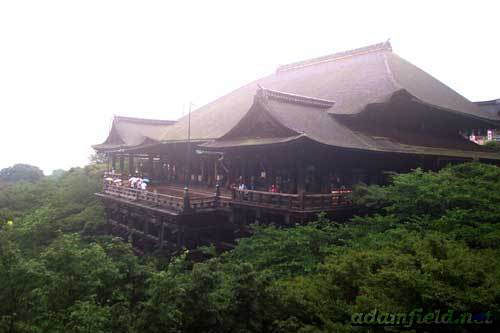 |
| Kiyomizu-Dera, perched on the side of a hill, has a spectacular view of Kyoto. A short walk down the hill, people drink from Otowa-no-taki, a waterfall with healing properties. |
 |
In addition to the main building, there were also a number of smaller temples containing statues of Buddha. The sound of the rain was periodically punctuated by the ringing of the prayer-bells attached to the front of these smaller buildings. At the bottom of the hill, inside the temple grounds, people were drinking from a waterfall with a reputation for miraculous restorative properties. I didn't partake as I'm a little reluctant to do more than observe another culture's beliefs.
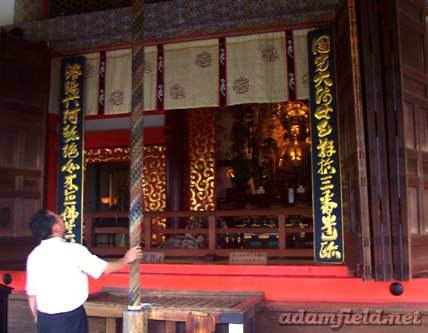 |
| A faithful Buddhist rings a prayer bell of one of the shrines at Kiyomizu Dera ( MP3-20KB) |
By the time I'd climbed the hill again and collected my bicycle, I was getting pretty fed up with the rain. However, determined to see at least one more thing that day, I headed back to the youth hostel and changed my socks. Then I headed off to the nearest attraction, Nijo castle. I arrived with only a little over an hour left before closing time. Inside a solid, yet somewhat boring, moat and wall was a beautiful set of gardens and a large old building. This building was constructed by the Shogun, a man fully aware that if you lived by the sword you probably wouldn't die in peace. His security arrangement against assassination by ninjas was to fill the place with nightingale flooring, floors that squeak musically as you walk over them. The passageways were about three meters wide, and the place was full of spacious unfurnished rooms decorated with 400 year old paintings.
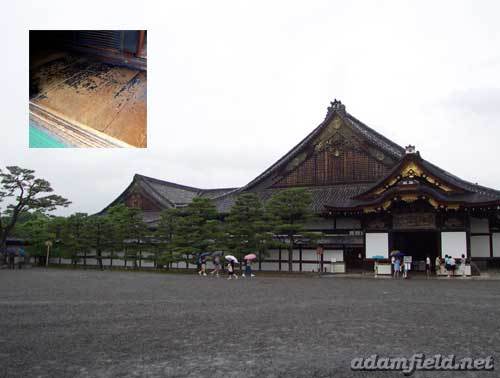 |
| Ninomaru palace, the main building of Nijo castle was constructed in the early 17th century. The home of the shogun, it contained 'nightingale floors' (inset), floorboards which creak no matter how lightly you tread on them ( MP3-91KB). |
The rain was starting to let up, but just as I was beginning to enjoy the castle, we were thrown out, as closing time was a confounding 4pm. It was OK, because I was starting to get hungry again. There's nothing like traveling to improve my appetite, so I stopped in at a convenience store for a meal tray.
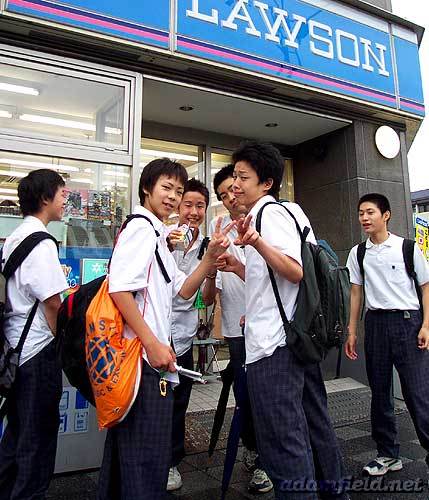 |
| A young group of Kyoto citizens gather outside of a convenience store. |
The day ended back at the youth hostel, where I popped out in the torrential rain for beer. The nearest vending machine was located just around the corner, and was well stocked with a variety of beer cans, from an expected 330ml all the way up to a spectacular 1 liter can. I sat around with the other travelers and together we killed a rainy evening.