| [ Home ] | [ Photo Diary ] | [ Image Gallery ] | [ Contact Me ] |
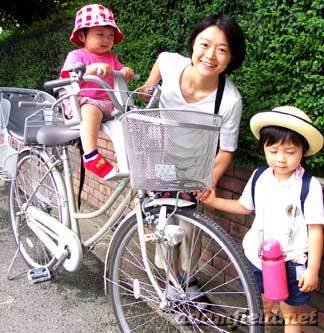
I got up bright and early, with a plan to do more exploring in Kyoto before returning to Nara. I packed and left my bags at the youth hostel, then headed out on another rented bicycle. Being out and about before 9am was interesting because I saw a lot of people starting their days. Herds of salarymen, dressed in impeccable suits, were cycling to work with their briefcases in the baskets on the front of their bikes. Mothers had young children on the backs, and sometimes on the fronts, of their bicycles. People seemed intent on carrying out their business, and there was a buzz to the streets in the centre of the city.
|
| A busy mother drops off her oldest child at school. Bicycle seems to be the preferred mode of transport in Kyoto. |
I was visiting two sites well outside of the hubbub of the city. It took me about an hour to get to the first as I took a roundabout route through the very interesting backstreets. There seemed to be no overall plan in the housing other than to squeeze as many buildings into as small a space as possible. Ever present were the overhead power lines and transformers.
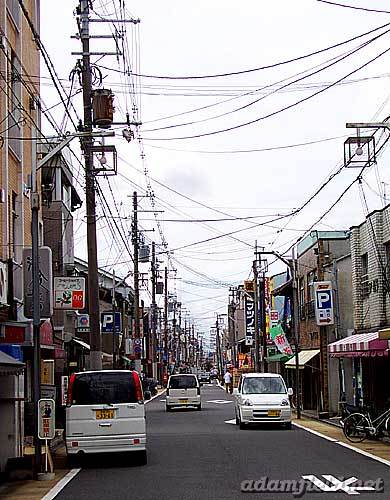 |
| Small cars, cluttered building and powerlines. A typical Kyoto sidestreet. |
I stopped at a small supermarket and picked up another lunch tray, and a carton of apple juice. It was great to be in a country where apple juice is popular. Korea is all about orange or grape juice. It's almost impossible to find apple juice. I didn't eat my lunch then, but waited until I reached my first stop, Ryoan temple, a world heritage site due to its ancient rock garden. I sat and quietly ate lunch. The sun had been shining that morning, and I noticed that I was starting to burn.
 |
| Meditating Tourists? The rock garden of Ryoan temple, 475 years old, attracts a steady stream of visitors. I didn't achieve enlightenment, but I spent a peaceful half-hour eating lunch and contemplating the gravel. |
The rock garden was surrounded by beautiful Japanese gardens, each tree and bush perfectly shaped, the paths meandering through as though rivers, and gardeners almost unnoticeably engaged in their quite, efficient, business. From there, onto another beautiful garden. The perfectly landscaped grounds of Rokuon temple. Made of wood, but covered with gold leaf, the temple glowed quietly at me from across a small pond. It's the places like this that are special in the world. During the second world war Kyoto escaped bombing by the Americans because of its historical significance.
 |
| The golden pavilion of Rokuon temple glows across its pond on a murky day in Kyoto. |
I cycled back to the youth hostel through the sidestreets, and as I got closer to the centre, the housing became even more compact. Cycling through these streets was very pleasant for two reasons. Firstly, I didn't have to fight with cars, as the streets were so narrow that few cars braved them. Secondly, the buildings were very interesting. Sometimes the houses, which generally fronted straight onto the street, had 'gardens' of bonsai and potted plants, which added an ironic splash of green once or twice per street.
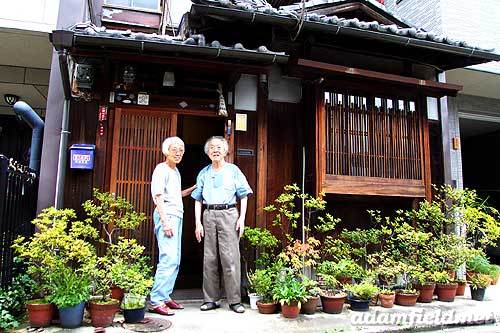 |
| An old couple stand outside of their house in the back streets of Kyoto. Gardens seem rare, and usually enclosed by high walls. Rows of pot-plants and bonsai are a common alternative. |
Collecting my bags from the youth hostel I headed back to Kyoto station, a huge wondrous modern monstrosity, dominating the skyline of the most historic city in Japan. It seemed to me like a large imposing shopping mall with a station added as an afterthought. I climbed to the top for a look over Kyoto, and aside from the station and one hotel with a large observation tower, there were no high buildings to be seen.
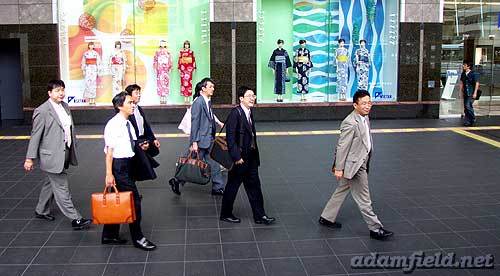 |
| A group of salarymen pass a window full of Kimonos outside of Kyoto station (top), a shopping mall at which trains stop. It's expansive, modern style (bottom) seems out of keeping with spirit of Kyoto, which just oozes history and culture. |
 |
Trains in Japan are efficient and fast. I had no problems getting to Nara, and when I arrived I had been doing so much moving around that I just sat down and read a book for three hours. When I finally got to wandering about I just picked a direction and went for a walk with no particular objective in mind. I was tired, and wanted to avoid crowds, and I found the perfect place to do just that. A small temple with a large graveyard about 30 minutes walk east of the station. I'm not sure if it was a graveyard or a collection of memorial stones in a temple garden, but it was a really peaceful setting.
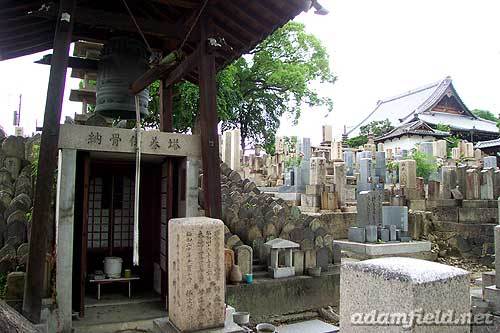 |
| A graveyard off the beaten track in Nara provided 30 minutes of peaceful reflection during a hectic day of exploring. |
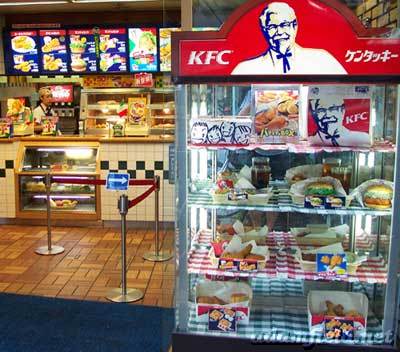
From the graveyard I headed back into the city to meet with Mako and Natsumi to eat. One interesting thing about Japanese restaurants is that they usually have models of their food in display cabinets outside, and pictures on the menus. I was rather amused when I noticed that this custom is not only for Japanese restaurants, coffee shops and ice-cream parlors, but it also extends to stores like McDonald's and KFC.
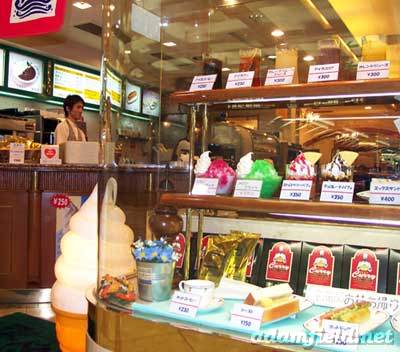 |
| Models of food grace the windows and display cabinets of Japanese restaurants from sushi bars to fast food joints. Fake food has been elevated to an art form. High-end models are made by hand, with each grain of rice crafted individually. |
 |
After a great meal of Oo-Dong (thick white noodles), and a bowl of something akin to very fluffy scrambled eggs, we parted company and I headed to where I was sleeping. The days of sightseeing were beginning to take their toll, and I could hardly keep my eyes open. Once my head hit the pillow I fell into a deep sleep.